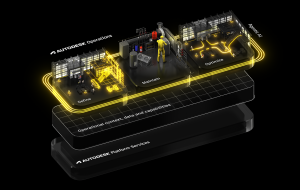
Buildings and products don’t stop generating information once they’re delivered. Every day they produce data. Data about how people move through them, how equipment and products perform, and where things break down. Most of that data never makes it back to the teams who designed and made the asset in the first place. Autodesk is closing that gap. For decades, Autodesk has helped customers design and make the world around us. Now we’re connecting both to operations, bringing day-to-day operational data back to design and make, helping teams make better decisions now and improve what they build next.
Why is Autodesk investing in operations?
The future isn’t about making design, construction, manufacturing, or operations better on their own. It’s about connecting them into one flow of information. We see that happening in three ways: bringing construction and manufacturing data together, connecting that data to what’s actually happening on-site in real time, and feeding operational insight back into the next design. Hartsfield-Jackson Atlanta International Airport, working with engineering firm WSP, shows what that looks like in practice, turning construction and manufacturing data into a single operations platform for the people running the busiest airport every day. They’re using Autodesk Tandem to help organize asset, model and operational data into a digital twin that can serve as a more reliable operational context for the airport. And these challenges–connecting design, build, and operations data–don’t just apply to airports, these are challenges we see across hospitals, factories, stadiums, and other complex facilities.
What is new in Tandem at AU 2026?
Tandem is Autodesk’s operations platform that brings spaces, systems, assets, processes, and operational data into a shared digital twin of the physical environment. At AU, we are showing an AI-powered Tandem integration with Forma, our industry cloud for AEC. Using Forma model coordination, teams can bring BIM and manufacturing data into the same project and use it as the foundation for a complete operational digital twin. Autodesk Assistant can also help connect sensor data to assets in Tandem, reducing the work required to build and maintain that operational view. That matters because the more complete the model is, the more useful the operational context becomes. Teams can see not only what an asset is, but where it is, what it connects to, how it is performing, and what has happened to it over time.
How can teams test operational changes before making them?
A digital view of operations is useful. Being able to test decisions against it is more useful. At AU 2026, we announced a new integration between Tandem and Flexsim, adding process simulation directly inside our operations platform. For example, using live airport data we can model TSA checkpoint flow, test different screening-lane configurations, and compare equipment utilization before a design decision is made. The point is practical: teams can use real operational context to explore options, find bottlenecks, test capacity, and avoid spending money on equipment or layouts that do not improve performance.
How does MaintainX turn operational insight into action?
Understanding a problem is only part of operations. Someone still has to take action to fix it. MaintainX, now part of Autodesk, brings maintenance execution and frontline workflows into our operations platform. At AU 2026, we are showing how Tandem can identify an asset operating outside its normal range and initiate a maintenance workflow in MaintainX before the asset fails. From there, a maintenance manager can prioritize and assign the work, while a technician can use the asset’s operating data, service history, and manufacturer documentation to diagnose the issue and complete the repair. Once the asset returns to service, the maintenance record becomes part of its history.
What happens when operations feed back into design?
Operations is where every design decision meets reality. Every maintenance event, equipment failure, repair, and performance improvement creates valuable operational knowledge. Too often, that knowledge stays trapped in maintenance systems or disappears when a project is complete. Autodesk is closing that loop. By connecting design, construction, and operations, teams can use real-world performance data to improve maintenance today and make better design decisions tomorrow. Instead of treating every project as a fresh start, each project can build on what was learned from the last. The result is a continuous lifecycle where operational insight improves asset performance, informs future investments, and helps teams design facilities that are easier to operate and maintain from day one.
Frequently Asked Questions
What is Autodesk Tandem? Tandem is Autodesk’s operations platform. It brings together the spaces, systems, assets, and processes of a physical environment into one connected digital twin, built from the construction and manufacturing data already used to design and build it.
What is MaintainX, and why is it joining Autodesk? MaintainX is a mobile-first, AI-powered maintenance and operations tool. Joining Autodesk gives Tandem a way to turn what it detects into action: an operational issue becomes an assigned work order with AI-generated repair guidance, instead of an alert someone has to act on manually.
How does Tandem connect with Forma and Flexsim? Forma’s model coordination service lets Tandem combine construction (BIM) data with manufacturing data in one project, giving it a fuller foundation for a digital twin. connected to Tandem lets teams simulate how a space or process would perform under different conditions before making a physical change.
How is Operations different from Autodesk’s AEC and D&M tools? Tools like Revit, AutoCAD, Civil 3D, and Fusion help create the built and manufactured world. Operations picks it up from there, connecting to how that world runs day to day, and feeding what happens back into the next round of design.
Can these connected operations workflows be applied beyond airports? Yes. Atlanta International Airport, working with WSP, is the customer example shown at AU 2026, but the same challenges—connecting design, build, and operations data—apply to hospitals, factories, stadiums, and other complex facilities.