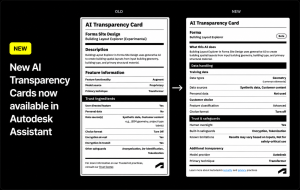
At AU 2026, it’s clear that AI is advancing what’s possible within Autodesk products, and we know trust and transparency are critical factors for customer adoption of AI tools. They want to know what an AI feature does and its limitations, what kind of data it is trained on, and the protections in place. To help address this, we’re releasing the next version of our AI Transparency cards, and because we know that questions often come up in the moment of use, we are bringing the cards directly into Autodesk Assistant.
What are AI Transparency Cards and what’s new with them?
AI Transparency Cards explain, in plain language, how each Autodesk AI feature works. Modeled after nutrition labels, each card lays out what the feature does, the models behind it, and how it was trained. We first released the AI Transparency Cards back in 2024 as first step towards answering some of those customer questions. Last year, we set out to test how well they were working and where the next version should go. Partnering with Deloitte, we ran research using the Trust ID framework, which distills trust into four factors: humanity, transparency, capability, and reliability. We asked customers the same questions about Autodesk’s brand and AI features before and after showing them a card. After seeing the cards, customers reported higher perceptions of transparency and reliability, and overall trust increased. But as customers understood more, their expectations rose with it. Transparency works, but not on its own. Customers also told us what else they would like to see: additional information on how our AI features are trained, and what safeguards are in place. So we started iterating. The original cards had two condensed sections: feature information and trust ingredients. The updated version adds dedicated sections on data handling, customer choice, safeguards, and model provider information.
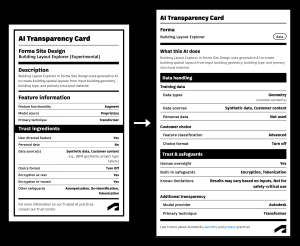
Old and New AI Transparency Cards for Forma Building Layout Explorer
Getting cards in front of more customers
Expanding the cards was one goal. The other is ensuring the information is available where and when customers need it. In talking with one customer, they told me that bringing a printed card into a meeting with his own client was enough to resolve their concern about using AI on the project. A single page settled a question that could have stalled the work. With the cards now part of Autodesk Assistant, we’re able to get cards in front of more people, in more of those moments.
How can customers get trusted answers about Autodesk AI?
Previously, customers could visit the Autodesk Trust Center to find AI Transparency Cards. As of this week, customers can also ask Autodesk Assistant directly: what an AI feature does, what data it processes, what safeguards and human oversight apply, what its limitations are, and which underlying model it uses. The answers name the card it draws from, and customers can open the card to read the source. This is available today in Autodesk Assistant, and we’ll keep improving it. A trust question usually arrives mid-task; someone is deciding whether to run a model on a client’s project. Now, customers no longer need to leave their workspace to ask it.
Frequently Asked Questions
Does Autodesk use customer data to train AI models? It depends on the feature. For certain features, training datasets include elements of customer content in aggregated and de-identified form, limited to common elements, industry standards, or other non-sensitive information. Autodesk does not share customer data with third parties for their own model training.
How does Autodesk AI use customer data? Autodesk draws on synthetic, licensed, open-source, and internal data to power AI features. Where Autodesk is authorized to use data to improve its own models, it applies safeguards suited to the data and its intended use, including data minimization, filtering, access controls, secure processing environments, and, where required, anonymization or pseudonymization.
What safeguards and human oversight exist for Autodesk AI? Before any new AI capability reaches customers, cross-functional teams from engineering, security, privacy, legal, compliance, and product evaluate it for data integrity, privacy requirements, model performance, and potential risks. That process is reinforced by Autodesk’s ISO/IEC 42001 certification and ongoing monitoring.
What happens if the information I’m looking for is not on the AI Transparency Cards? If a card doesn’t cover the question, Autodesk Assistant says so. For additional questions, you can always visit the Autodesk Trust Center.