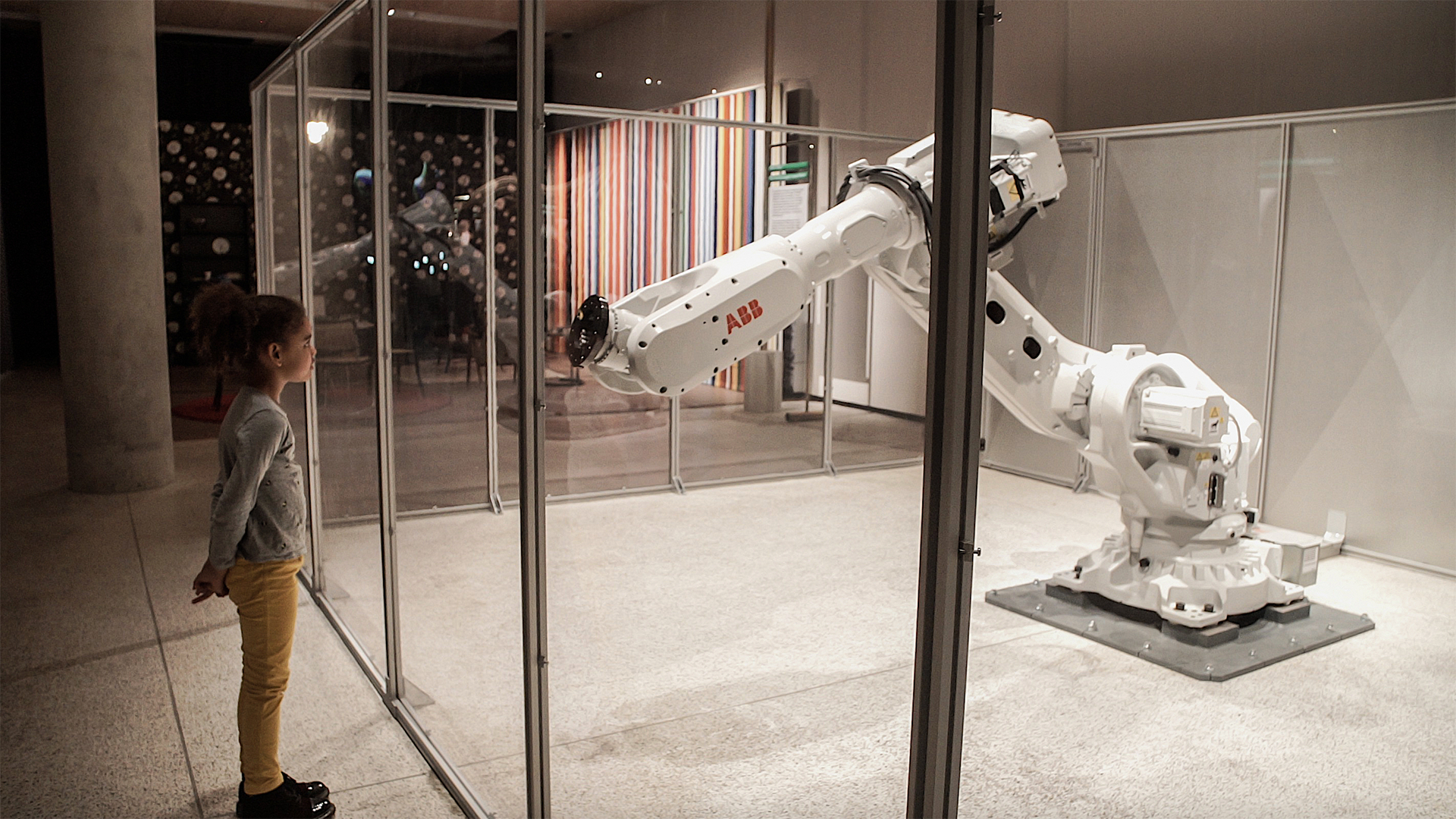
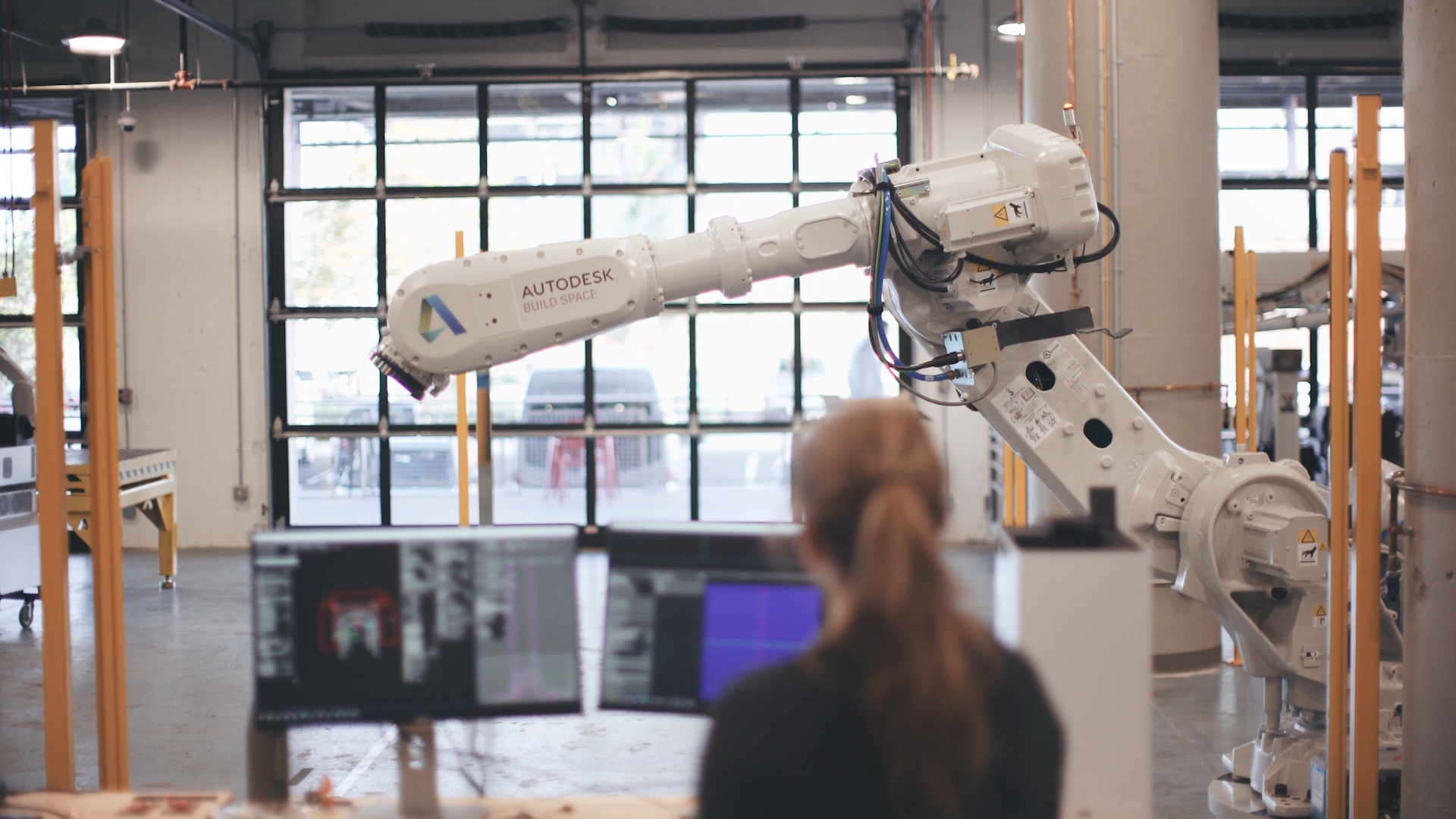
Madeline Gannon, founder of ATONATON and renowned “robot whisperer” has unveiled her latest project at the new London Design Museum. “Mimus,” is an industrial robot that has been designed to sense and respond to the presence of people and explores the interaction between human and machines. Unlike traditional industrial robots, there are no pre-planned movements in Mimus – she explores and roams about her ‘enclosure’ freely, never taking the same path twice. The project relies on a combination of data captured from sensors, simulation algorithms that drive the robot’s movements and behaviors, and specially developed gesture-based software. Madeline developed the technology while working in residence at the Autodesk BUILD Space in Boston.
Image of Mimus at the Design Museum. Courtesy of Madeline Gannon and Autodesk, Inc.
“Creating new ways to communicate with machines is my passion, and I’m really excited to share this experience with others through Mimus,” explained Madeline. “Despite our collective fears and anxieties surrounding the rise of robotics, we have the power to foster empathy and companionship between people and machines. With Autodesk championing my work at their Pier 9 Workshop and Autodesk’s new BUILD Space, I have had the physical and mental space to freely experiment and push the boundaries of what’s currently possible in robotics.”
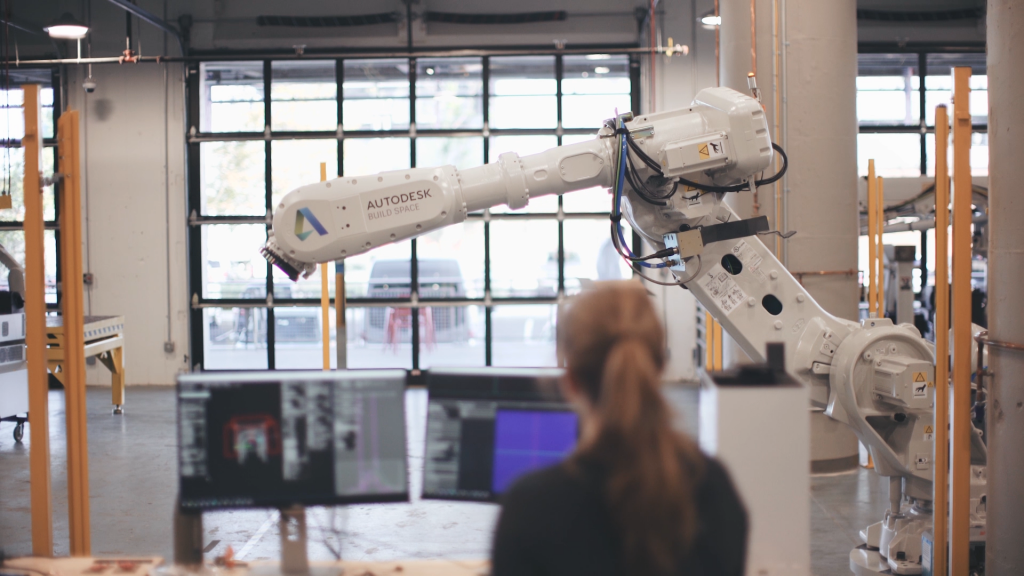
Mimus at the Autodesk Boston BUILD Space. Courtesy of Madeline Gannon and Autodesk, Inc.
“The big void in robotics is being able to communicate with the hardware in a way that allows them to be dynamic and adaptable. Currently, these huge machines do the same thing their entire lives. In the future, robots will be more entrenched in our daily lives as designers, builders and engineers. Humans and robots working together will allow things to be made that neither could achieve on their own. Madeline and Mimus highlight how that new relationship can emerge,” said Amar Hanspal, senior vice president, Autodesk. The ideas behind Mimus took shape around a year ago during Madeline Gannon’s time as an artist in residence at the Autodesk Pier 9 Workshop in San Francisco. During her residency, she developed a gesture-based software called
Quipt, which gave industrial robots basic spatial behaviors for interacting closely with people. This project became a useful proof-of-concept for Mimus. It demonstrated how an industrial robot can exist outside of a traditional industrial setting and how life-like movements enable the robot to communicate some form of intelligence and awareness of the people around it.
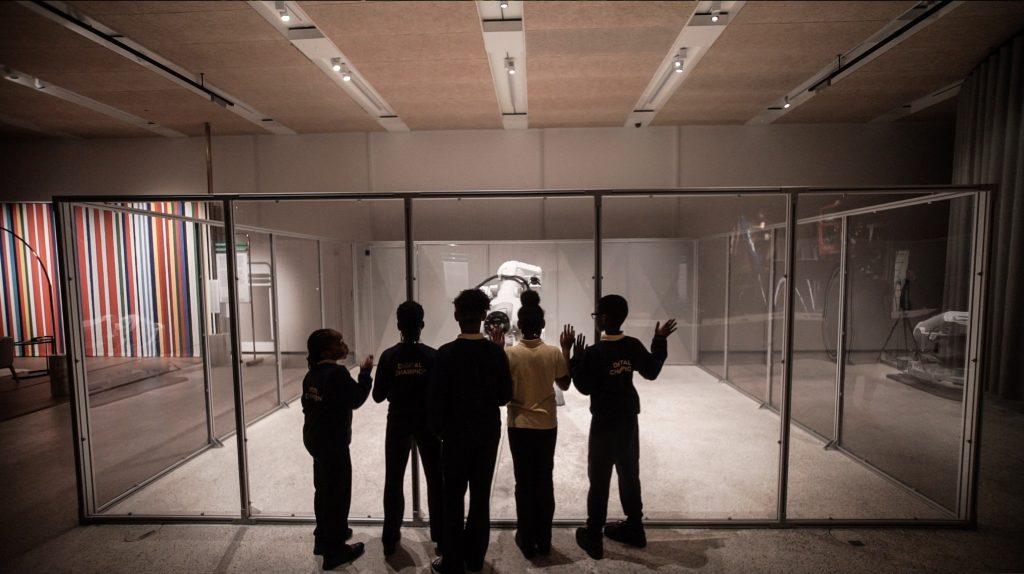
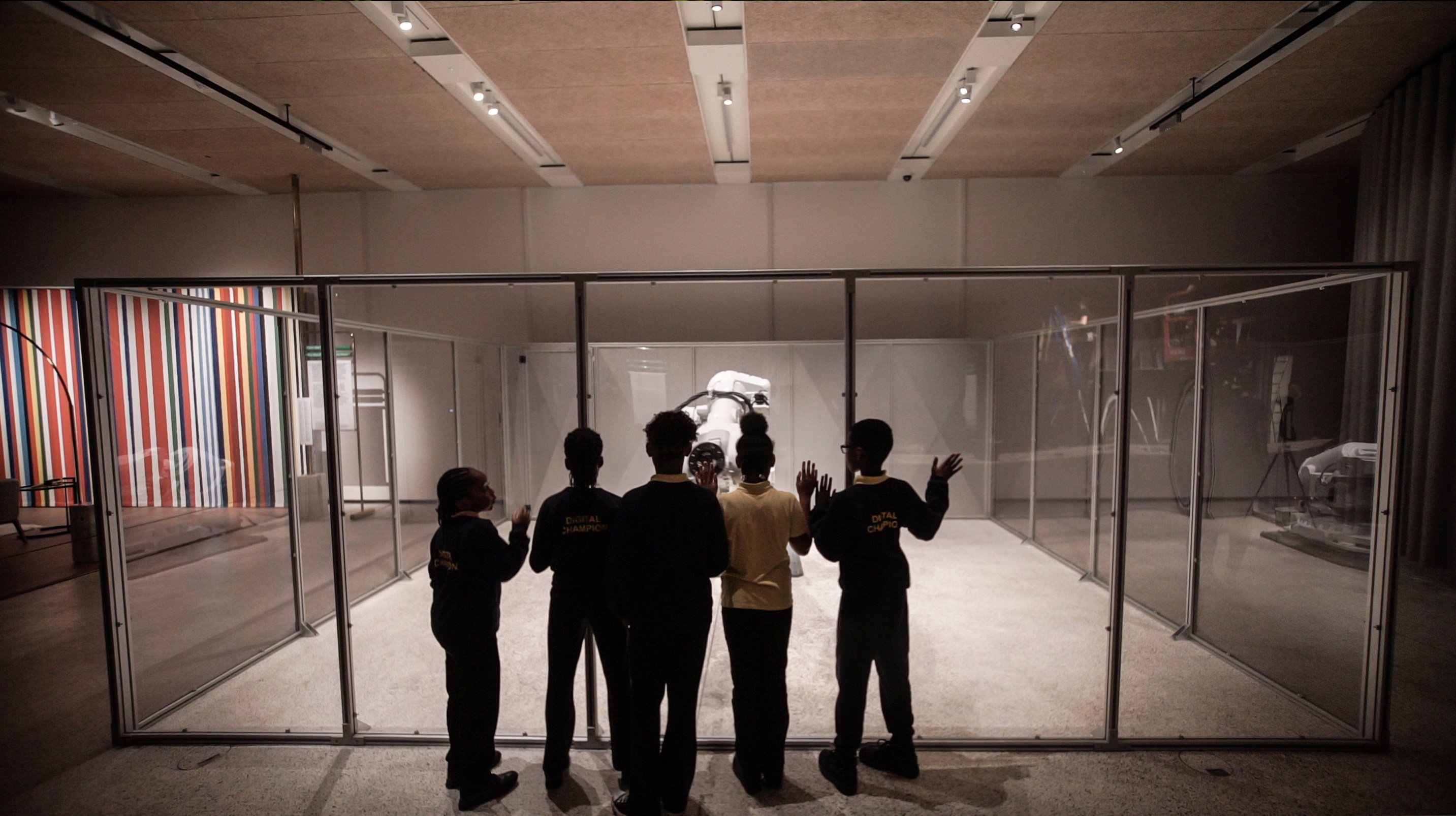
Primary school students in London interact with Mimus at the Design Museum. Courtesy of Madeline Gannon and Autodesk, Inc.
“What’s fascinating is the way Madeline has subverted the robot by reprogramming it, taking something designed for industrial repetition and making it seem alive and spontaneous. One starts to get the sense of how robots may behave in the future.” – Justin McGuirk, chief curator of the Design Museum Mimus is one of eleven large scale installations at The Design Museum’s inaugural exhibit ‘Fear and Love’ at its new location on Kensington High Street, London. The exhibit runs from 24th November 2016 – 23rd April 2017. You can find more in depth information on the design and technology behind Mimus
here.
https://vimeo.com/pier9/Mimus About Madeline Gannon and ATONATON Madeline Gannon heads
ATONATON, a research studio inventing better ways to communicate with machines. In her research, Gannon designs and implements cutting-edge tools that explore the future of digital making. Her work blends disciplinary knowledge from design, robotics, and human-computer interaction to innovate at the edges of digital creativity. Gannon is also completing a PhD in Computational Design at Carnegie Mellon University, where she is developing techniques for digitally designing and fabricating wearables on and around the body.
About the Design Museum The Design Museum is building the world’s leading museum devoted to architecture and design, its work encompasses all elements of design, including fashion, product and graphic design. Since it opened its doors in 1989 the museum has displayed everything from an AK-47 to high heels designed by Christian Louboutin. It has staged over 100 exhibitions, welcomed over five million visitors and showcased the work of some of the world’s most celebrated designers and architects including Paul Smith, Zaha Hadid, Jonathan Ive, Miuccia Prada, Frank Gehry, Eileen Gray and Dieter Rams. The Design Museum is relocating to a 1960s building in Kensington, west London. The Design Museum will reopen on 24 November 2016. Leading architectural designer John Pawson has converted the interior of the building to create a new home for the Design Museum giving it three times more space in which to show a wider range of exhibitions and significantly extend its learning programme.