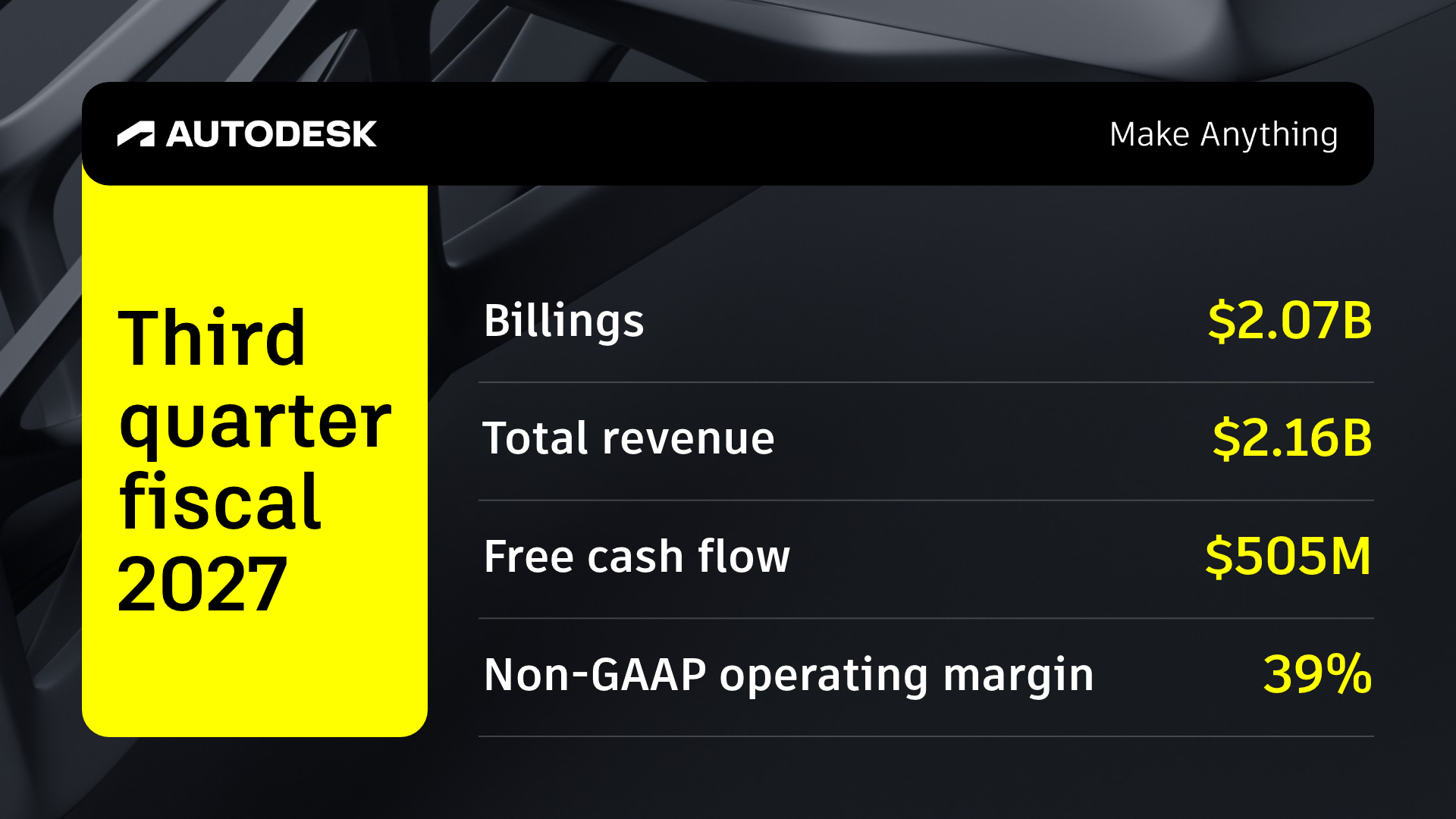
Autodesk reported results for the third quarter of fiscal 2027 (ended October 31, 2026). Autodesk continues to execute consistently, balancing growth with strategic investments in the right areas to increase customer value. Here are five takeaways from the quarter.
1. Revenue and EPS came in above guidance
Revenue was $2.16 billion, up 17% year over year as reported and 14% in constant currency. Non-GAAP earnings-per-share (EPS) was $3.20. Both revenue and EPS were above the high end of guidance. Billings reached $2.07 billion, up 12% as reported and 13% in constant currency, driven by consistent underlying business momentum, with strength in construction and emerging markets, and strong renewal rates.
2. Autodesk raised its full-year billings and revenue outlook
Autodesk raised the FY27 billings midpoint to $8.625 billion and the revenue midpoint to approximately $8.368 billion. The increases reflect strong Q3 execution and improved underlying expectations for the rest of the year, partly offset by dollar appreciation. Autodesk also raised its non-GAAP operating margin outlook to a range of 39.2 to 39.3 percent, while maintaining its free cashflow outlook in the range of $2.725 billion to $2.750 billion.
3. AI is turning project information into project intelligence
Autodesk is executing its long-term strategy to connect data, context, and experience across design, make, and operate. AI can turn that project intelligence into action by automating complex work, making specialized expertise more accessible and helping customers do more with the resources they have. Autodesk is building toward a future where customers can access its trusted engineering capabilities through Autodesk’s own AI experiences or other AI tools and agents. In a focused test, a global engineering consultancy reported more than 90% less drawing-generation time using an AI-orchestrated workflow. It estimates net savings could still reach at least 50% after full production review and quality assurance.
4. Customers are connecting work across the asset lifecycle
From buildings and data centers to manufacturing, energy, and water infrastructure, customers need connected data and workflows to plan, design, build and operate increasingly complex assets. For example, DPR Construction uses Forma Build and Rhumbix from preconstruction through jobsite execution; A major regional water utility in the UK expanded Forma to connect capital project delivery with water-asset operations. In manufacturing, a global engineering and product development company from India selected Fusion to extend from simulation into AI-assisted design.
5. MaintainX is contributing in its first quarter within Autodesk
MaintainX generated nearly $33 million in revenue, with integration progressing as planned. The acquisition expands Autodesk’s ability to help customers manage and maintain assets after they’re built—extending its strategy across the full design, make and operate lifecycle–with plans to extend into more geographies and segments next year. Read more:
- Full press release
- Investor presentation, Excel financials & supplemental materials: autodesk.com/investor
- Earnings webcast replay: autodesk.com/investor
This post contains forward-looking statements; actual results may differ. See the full press release and Autodesk’s SEC filings for details and the complete safe harbor statement.