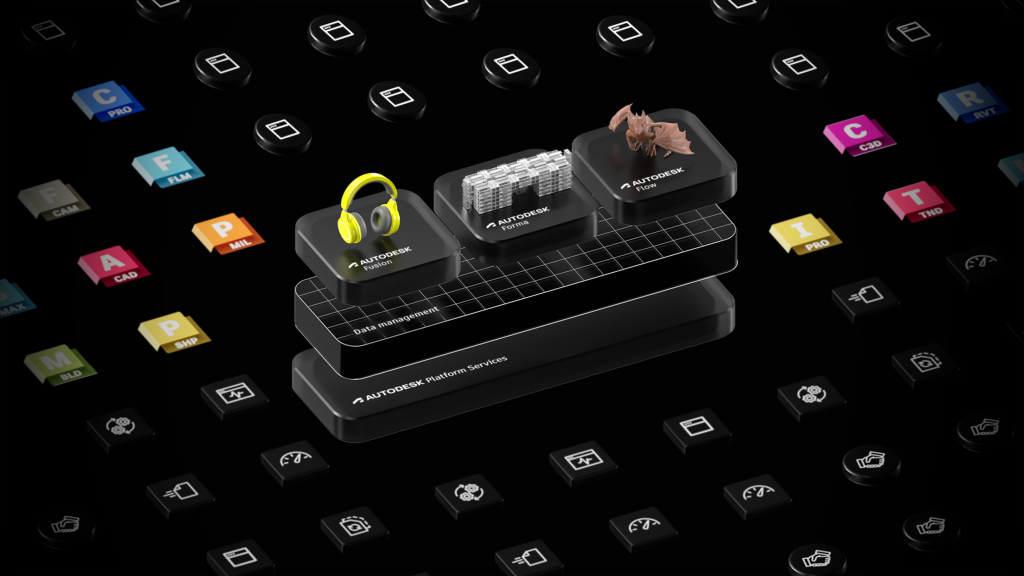
AI in design and make will be built on continuity – where knowledge, intent, and context move fluidly across the lifecycle of projects, products, and productions.
Eight years ago, we made a bet. Design and make were converging, but disciplines were still working in silos with disconnected tools, fragmented data and broken handoffs at every phase. We knew the companies that would lead this next era were the ones that could connect their people, processes, and data across every phase of work. That is why we set down this path: to move our customers toward a more connected way of working where knowledge, context and data flows seamlessly across teams, disciplines, and industries. Since then, we’ve been steadily building the foundation to make that vision real. Most AI in our industry is being bolted onto disconnected tools. Because we spent years building connected data and workflows, our AI has something to work with – real project context, design intent and operational history, all in the tools our customers are using today.
Connecting the full lifecycle in AEC
For the first time, project knowledge doesn’t have to start over at every phase. Our customers need AI that understands the project goals, constraints, workflows, and decisions made three phases ago. That’s what Forma makes possible and what we’ve continued advancing since AU25. One of the most significant milestones has been the launch of Forma Building Design, which helps teams explore and evaluate schematic design options earlier while maintaining continuity into detailed design workflows. We also introduced Revit as the first Forma Connected Client in Tech Preview and brought Autodesk Construction Cloud capabilities into Forma – important steps toward a more connected industry cloud where teams can work from shared context and connected project data. We’re continuing to explore how AI can support more informed decision-making with context. Building Layout Explorer gives teams the ability to generate and evaluate floor plan options from early massing studies while keeping designers in control of outcomes. Together, these updates point to a more connected way of working across AEC — one where project knowledge builds over time, decisions are easier to understand and revisit, and AI helps teams move with more clarity and confidence from early planning through delivery and operations.
Expanding AI-powered workflows in Design and Manufacturing
In Design and Manufacturing, we’ve continued to expand Autodesk AI to enable customers to iterate faster and reduce friction in increasingly complex product development workflows. A major milestone has been the rollout of Autodesk Assistant across the entire Design and Manufacturing Portfolio: Fusion, Inventor, Moldflow, Vault and most recently in VRED and Alias. Autodesk Assistant is designed to understand 3D models with industry context inside our products – helping users complete tasks, surface information, and streamline work in more natural and intuitive ways. We’ve also introduced new Fusion Model Context Protocols (MCPs), giving developers and technical teams the option to extend Autodesk tools to fit their needs in their own environment. Through the launch of the Fusion MCP for Claude, we’re also extending Fusion into third party AI marketplaces where customers can use natural language to drive design action. Grounded in decades of industry expertise and contextual understanding, these capabilities are designed to meet customers where they are – from out-of-the-box assistance to tailored solutions.
Connecting creativity and intelligent workflows in Media and Entertainment
In Media and Entertainment, the lifecycle challenge is the production pipeline. Getting from idea to final frame requires several handoffs where time can be lost and creative momentum is stalled. Studios already understand AI will change production but want to know if it will leave room for their craft. We’re doing exactly this by shortening the path from idea to final frame with AI capabilities that enhance creative workflows while keeping creators firmly in control. This year’s releases are designed to remove friction and get them to creative decisions sooner. MotionMaker enhancements in Maya give animators AI-powered motion archetypes that generate realistic base motion faster. This gives them more time for refining performance and storytelling. Wonder 3D takes that further with a generative AI model for text-to-3D and image-to-3D creation in Autodesk Flow Studio, enabling artists to generate characters and assets from text prompts or reference images, faster and more intuitively than before. And with AI Rigging and Neural Layer now in Flow Studio, we’ve moved beyond asset generation to achieve a complete character performance platform. Across media and entertainment, creators are looking for technologies that reduce friction without compromising artistry. Our focus remains on building tools that augment creativity, modernize production workflows, and help our customers spend more time creating.
Building toward the future of physical AI
Eight years ago, we made a bet that connecting the full lifecycle was what’s needed to move our industries forward. That bet is paying off. We have spent years building the foundation that makes our AI different from anything else out there – grounded in specialized data, end-to-end workflow context and the expertise to deliver product experiences tailored to the specific needs of Design and Make professionals. The next era of physical AI will be built on continuity – where knowledge and context move with the work across every phase, team and discipline. The foundation took years to build What gets built on top of it now will move much faster.