The Fast Company’s Most Innovative Companies 2026 list identifies enterprises at the forefront of their industries.
I’m proud to share that Autodesk has once again been named one of Fast Company’s Most Innovative Companies, recognized for the second year in a row in the Architecture category. For 2026, Fast Company highlighted our work supporting historic and cultural preservation through digital technology. This recognition reflects how architects, engineers, and preservation experts are using Autodesk technology to protect and restore some of the world’s most significant cultural landmarks, including the Notre-Dame de Paris Cathedral and Frank Lloyd Wright’s Fallingwater. Autodesk is best known for helping our customers to design and make the buildings and infrastructure that shape our world. But innovation isn’t only about what we build next, it’s also about protecting the places that connect us to our shared history. Historic landmarks face increasing threats, from the impacts of climate change and aging infrastructure to natural disasters. Preserving these sites requires more than traditional restoration. It requires precision, documentation, coordinated planning, and digital records that protect this knowledge for generations.
Digital preservation of Notre-Dame de Paris, Fallingwater, and global heritage sites
Following the 2019 fire at Notre-Dame de Paris, Autodesk partnered with Art Graphique et Patrimoine (AGP) to create and donate a detailed 3D BIM model to support the French Public Establishment, “Rebâtir Notre-Dame de Paris,” in charge of its reconstruction. Using laser scanning data and photogrammetry, the model enabled restoration teams to simulate wind and lighting conditions, improve coordination between restoration teams, construction site planning and sequencing, enabling more than 2,000 architects, engineers and specialists across over 250 companies to work from a shared source of truth while rebuilding one of the world’s most complex historic structures. When the cathedral reopened in December 2024, just five years after the fire, it demonstrated what’s possible when traditional craftsmanship and digital innovation work together.
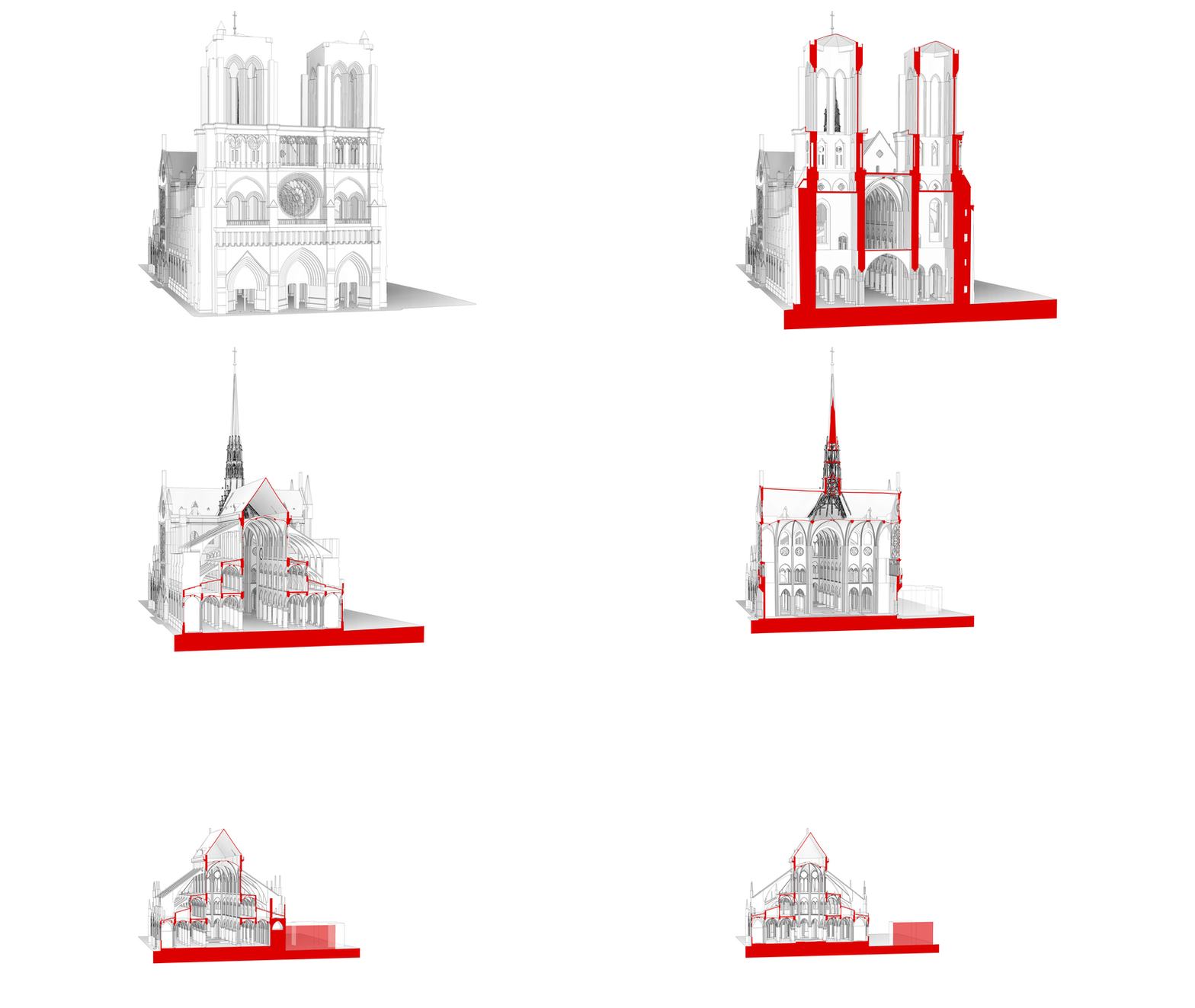
The 3D BIM model of the Notre-Dame de Paris. Courtesy of The Public Establishment Rebâtir Notre-Dame de Paris Cathedral and Art Graphique & Patrimoine.
At Fallingwater–Frank Lloyd Wright’s architectural masterpiece and a UNESCO World Heritage Site–Autodesk is collaborating with Case Technologies and the Western Pennsylvania Conservancy to digitally document the structure using reality capture and scan-to-BIM workflows. Drones and laser scanners captured millions of data points to create a highly accurate digital twin of the building and its surrounding landscape. This now helps preservation teams analyze structural conditions, plan restoration work, and maintain a long-term digital archive of the site.
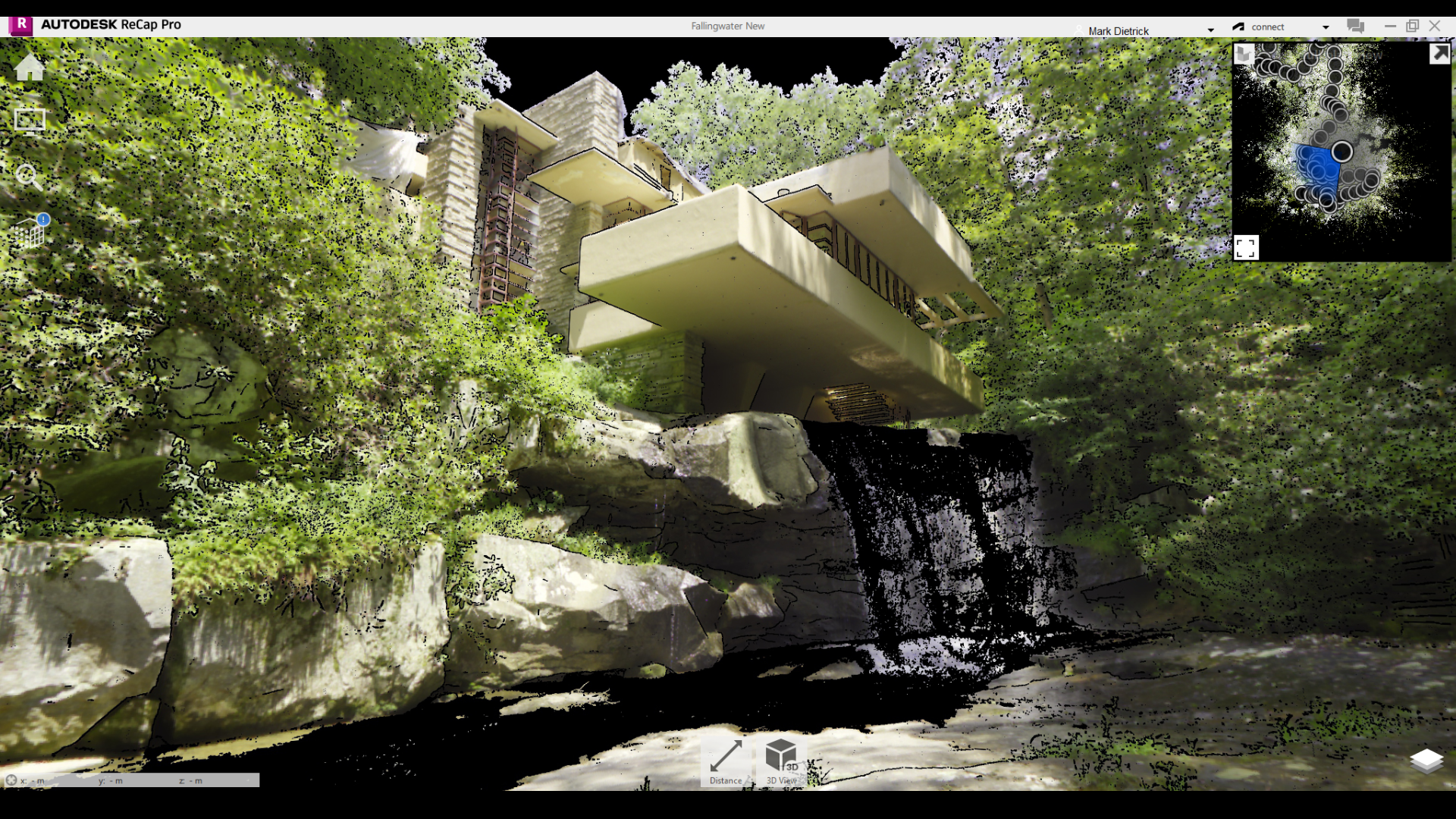
Point cloud of Fallingwater in Autodesk ReCap Pro, created through reality capture to support restoration planning and long-term preservation. Courtesy of Case Technologies.
Autodesk has also supported preservation initiatives with Warren and Mahoney at Christ Church Cathedral in New Zealand and, for more than a decade, we’ve partnered with Case Technologies to advance preservation and digital heritage initiatives in the historic city of Volterra, Italy. Together, these projects demonstrate how digital workflows can strengthen preservation practices and safeguard historic knowledge, ensuring that it endures when physical structures are at risk.
Scaling digital preservation for the future
Preserving cultural heritage is about more than restoring buildings. It’s about protecting identity, memory, and community. Technology is helping restoration teams capture and document historic structures with unprecedented precision while enabling more collaborative and informed decision-making. Tools such as BIM, reality capture, and cloud collaboration are becoming foundational to modern preservation efforts. These technologies allow teams to move from reactive repairs to proactive, data-driven stewardship, helping historic sites remain resilient for decades to come. None of this work happens alone. We’re grateful to our partners including Art Graphique et Patriomoine, Rebâtir Notre-Dame de Paris, Case Technologies, the Western Pennsylvania Conservancy, Warren and Mahoney, and the many architects, engineers, and preservation specialists whose expertise brings these projects to life. Being named a Fast Company Most Innovative Company reflects Autodesk’s commitment to purposeful innovation–helping our customers design and build what’s next while protecting what matters most for future generations. Because designing and making a better world also means preserving the one we’ve inherited.