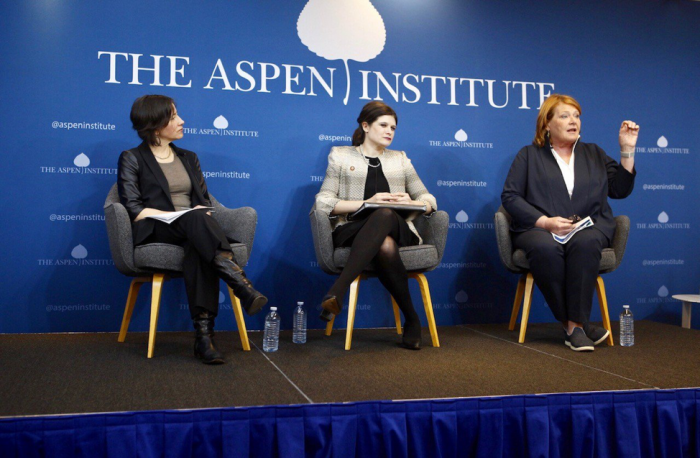
From left – Lauren Weber, Wall Street Journal; Congresswoman Haley Stevens (MI-11) and Senator Heidi Heitkamp (ND) discuss the importance of quality workforce training and a tax code that rewards investment in workers during the April 4 event in Washington DC.
Earlier this month, the
Aspen Institute’s Future of Work Initiative, with the support of the
Autodesk Foundation, launched a first-of-its-kind report that recommended ways the US economy could prepare for the future of automation and its impact on jobs — an important first step in alleviating deeply seeded anxieties about the upheaval automation may bring.
The report, Automation and a Changing Economy, outlines how policymakers and government can best prepare the American workforce for changes brought about due to technological advancements. This research is one part of a multipronged strategy that we at the Autodesk Foundation have developed to help people adapt to the future of work – and ultimately reduce, not compound, inequality among workers.
Most importantly, we believe that technology is not destiny.
To launch the report, the Aspen Institute hosted an event in Washington, D.C. to discuss the findings, and I was thrilled and humbled to provide opening remarks highlighting why we funded this important research which is crucial to the work of the Foundation and society writ large.
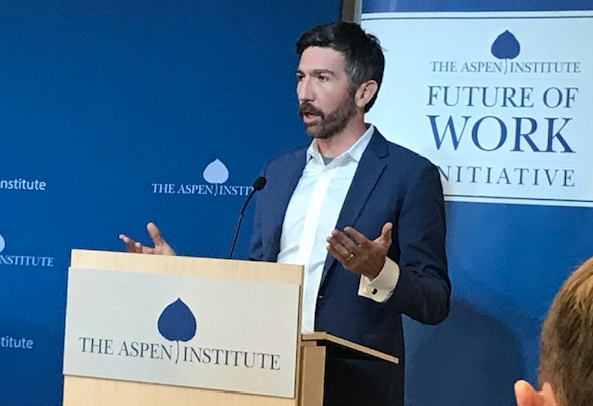
The author presented the opening remarks of the summit.
I’m excited to see the work result in recommendations that are actionable and solutions-focused. The authors encourage key stakeholders to lead with a human-centric approach to automation; enable workers to access skills training, good jobs and new economic opportunities; help people and communities recover from displacements; and understand the impact of automation on the workforce.
Policymakers play a crucial role in guiding society through these massive changes.
The symposium was full of energy, thoughtful debate, and sobering statistics. The first panel, moderated by reporter Lauren Weber of The Wall Street Journal, was an engaging conversation with Congresswoman Haley Stevens of Michigan’s 11thdistrict (her district includes our Novi, MI, office) and former North Dakota Senator Heidi Heitkamp. The lively discussion focused on the current skills gap (which is often overlooked) and how new technologies in advanced manufacturing hold significant promise for driving economic growth. Congresswoman Stevens highlighted how her district–which includes the global automotive capital– has gone from double-digit unemployment to being a leader in autonomous vehicle development – a transition made possible by human capital investment. Senator Heitkamp emphasized the importance of investing in automation and AI while stressing the importance of bringing people alongside. Both agreed that policymakers play a crucial role in guiding society through these massive changes.
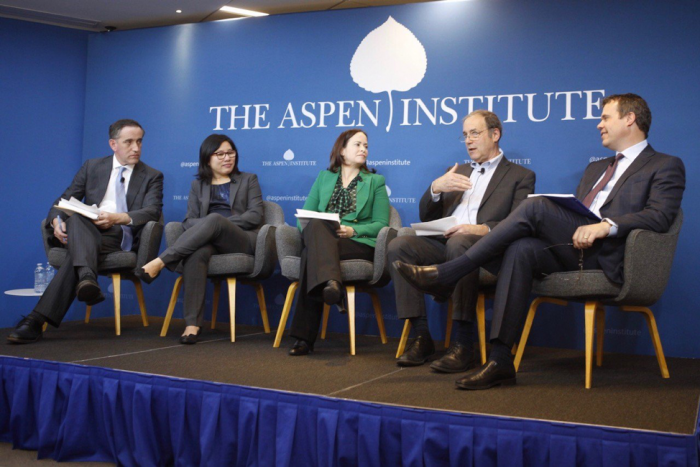
“We need to take the job quality issue seriously as part of the training conversation,” says Jon Hiatt.” If the jobs workers are re-trained for are not attractive, with decent wages and benefits, we still have a problem.” (From left: Alistair Fitzpayne, Aspen Institute; Portia Wu, Microsoft; Ambassador Kristen Silverberg, Business Roundtable; John Hiatt, U.S. Solidarity Center; and Scott Rutherford, McKinsey & Co.)
Another panel focused on the economic security of American workers and how automation is affecting the labor market. Experts from policy institutions and academia discussed how historical instances of automation have impacted workers today and how initiatives like unique training programs could help the future workforce to be more resilient in the face of disruption. Current research points to inequality in the impact of automation on workers, with Black and Latino workers concentrated in jobs at high risk for automation. And geographically, places with lower education levels and a history of manufacturing–often rural areas–have been hit first by challenges of automation. The last panel was moderated by Alistair Fitzpayne, the Executive Director of the Aspen Institute’s Future of Work Initiative. He examined some of the proposed solutions and discussed the programs – at local, regional and national levels—that are already in place to support a changing workforce economy. Panelist Portia Wu of Microsoft, and formerly of the Department of Labor, shared examples of programs she advises at the local level, providing a connection between smaller, local or regional employers with an indication of where automation may be heading or how to best prepare for the anticipated challenges. In their own
blog post, the Aspen Future of Work Initiative outlined four key takeaways from the day’s panel discussions:
- Every industry will be affected by automation, so ensuring that the gains from automation are broadly shared will require prioritization across sectors.
- We have to work together on this. Coordinated efforts and partnerships are critical to creating positive outcomes for workers.
- These issues concern everyone, so the discussion about preparing workers for the future must include broad stakeholder representation.
- We need better data to understand what is happening and how to plan for the future.
Technology alone will not determine our future. By helping workers take advantage of new opportunities and assisting workers who are negatively affected by automation return to stable work, we can promote greater opportunity and broadly shared prosperity for all. Learn more: