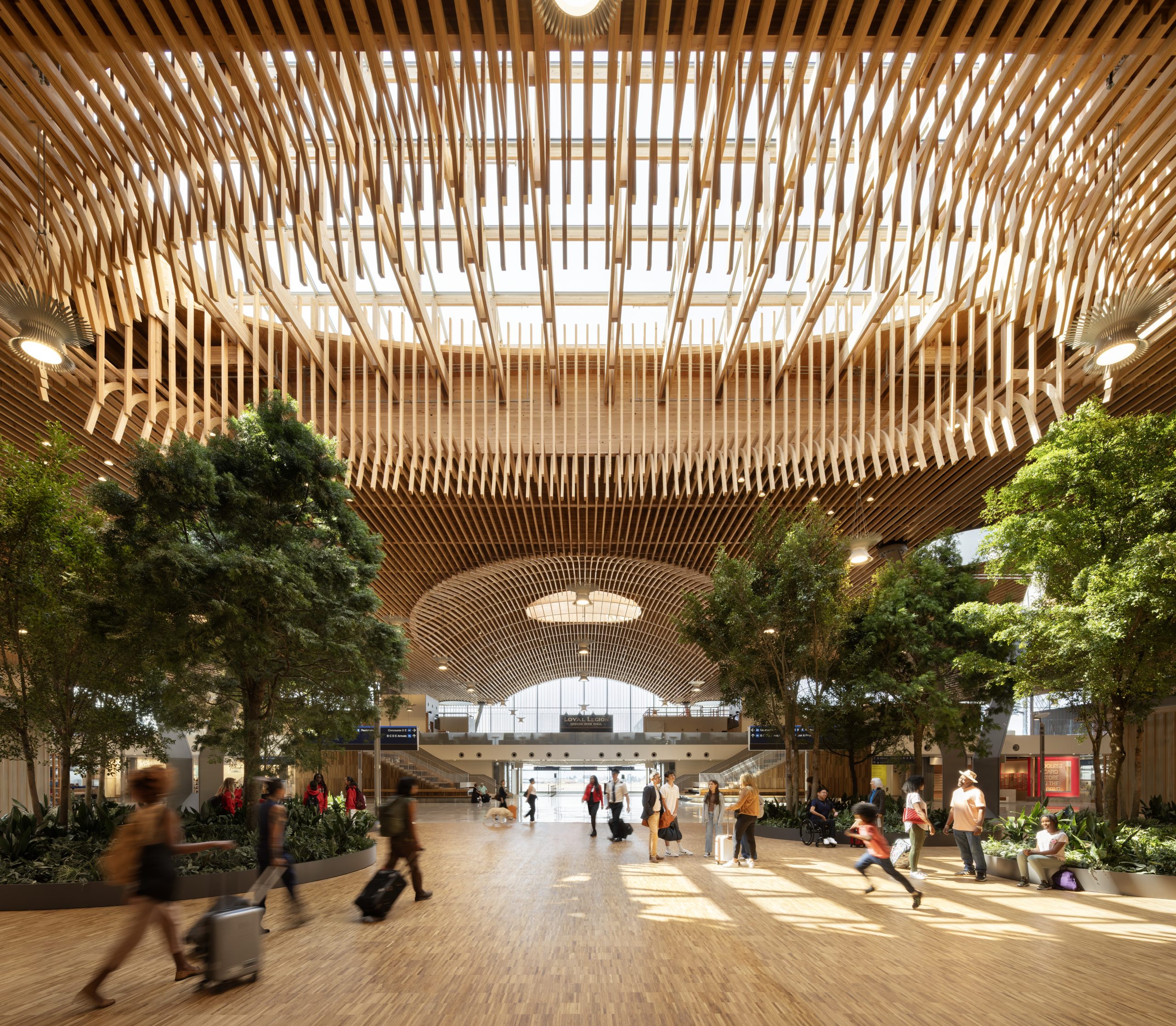
PDX has long been known for its connection to place and nature, incorporating elements of wood, plants, and natural daylight into its design. Image credit: Ema Peter.
When travelers step into the newly reimagined terminal at Portland International Airport (PDX), the experience feels different. Natural light fills the space. A sweeping mass timber roof stretches overhead. People pause, look up, and take it in. Behind that moment is a highly coordinated effort—one powered by connected digital workflows. The Terminal Core Redevelopment Project (TCORE), part of the Port of Portland’s PDX Next program, is transforming one of the Pacific Northwest’s busiest airports while keeping it fully operational. Led by a joint venture between Skanska and Hoffman Construction, with design by ZGF Architects, the project doubles passenger capacity and redefines what an airport experience can be. With the majority of the project now complete, it is also a clear example of how cloud-based collaboration is changing the way complex infrastructure gets built.
Designing with a shared understanding
PDX has long been known for its connection to place and nature, incorporating elements of wood, plants, and natural daylight into its design even prior to the redevelopment. Expanding the airport meant balancing growth with that identity, while navigating decades of existing infrastructure. Using Autodesk Revit, the project team built detailed models of both the existing terminal and the future design, creating a digital foundation for decision-making. With Autodesk ReCap Pro, those models were enriched with reality capture data, helping teams visualize real-world conditions and better understand how new construction would integrate with what was already in place. That clarity proved essential early on. By presenting these models to stakeholders, the team was able to communicate complex conditions more intuitively while building alignment and trust with the Port of Portland and project partners.
Connecting teams in the cloud
As the project moved into construction, coordination became the defining challenge. The hundreds of companies involved on the project needed to stay aligned, all while the airport remained open to travelers. Autodesk Forma provided a shared, cloud-based environment where teams could access and update information in real time. Instead of working from disconnected files, architects, engineers, contractors, and owners collaborated within a single source of truth. This connected approach improved visibility across the project, helping teams identify clashes earlier, validate design intent, and provide teams with access to the latest data. “Working in a connected environment meant every team could see how their decisions impacted the bigger picture,” said Joe Schneider, senior vice president – account manager, Skanska. “It helped us stay aligned, address issues sooner, and keep the project moving with far greater clarity and coordination.”
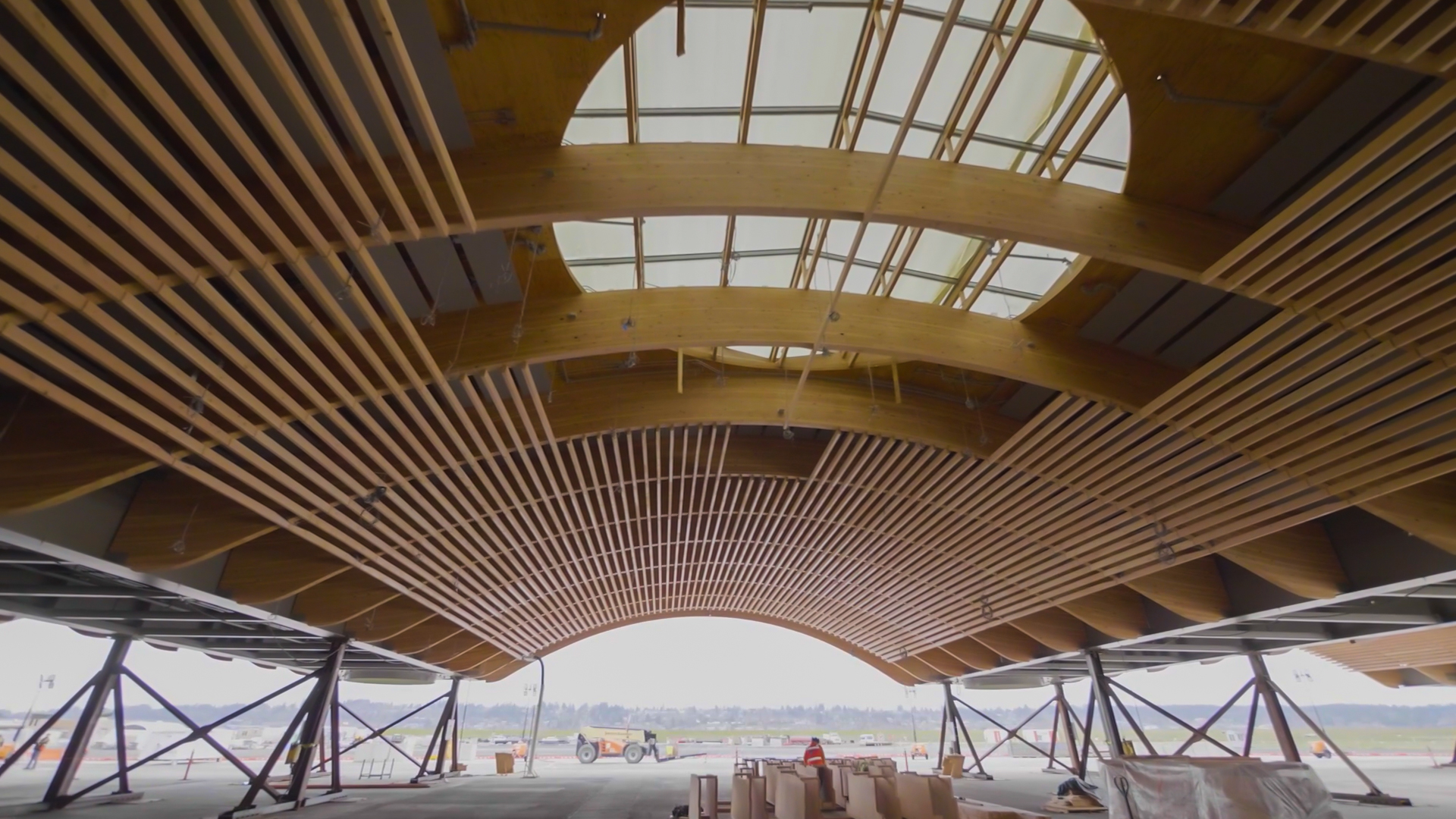
Spanning nine acres and supported by just 34 columns, the installation of the mass timber roof required tight collaboration among project teams.
That shared foundation was especially critical for one of the project’s most complex elements: the mass timber roof. Spanning nine acres and supported by just 34 columns, its installation required a level of precision more often seen in manufacturing than construction. Using detailed models, the team planned every step of the process—from prefabricating roof modules to transporting them across the airfield and lifting them into place. These simulations allowed teams to align on sequencing and logistics well before construction began, while also making it easier to communicate plans to stakeholders, including airport operations, air traffic controllers, and the FAA. Those same models also informed sustainability outcomes. Arup’s team analyzed Revit models to quantify materials across the façade, roof, and structure. This approach enabled precise measurement of complex elements like curved timber beams and branching steel columns. By organizing the model to distinguish existing and new construction, the team was able to demonstrate a 22% reduction in embodied carbon for the new second floor, and a 66% reduction when accounting for the reuse of the existing ground floor. Because all teams were working from the same shared data environment, plans stayed coordinated and up to date as the project evolved—helping reduce risk, minimize disruption, and enable confident execution at scale.
A more connected way to build
As the final phase of the multi-year redevelopment project nears completion, the impact of that connected approach is clear. What feels effortless to passengers is the result of thousands of coordinated decisions, made possible by teams working together on a shared digital foundation. PDX demonstrates how technology can bring design and construction closer together, helping teams move faster, reduce risk, and deliver projects with greater confidence.