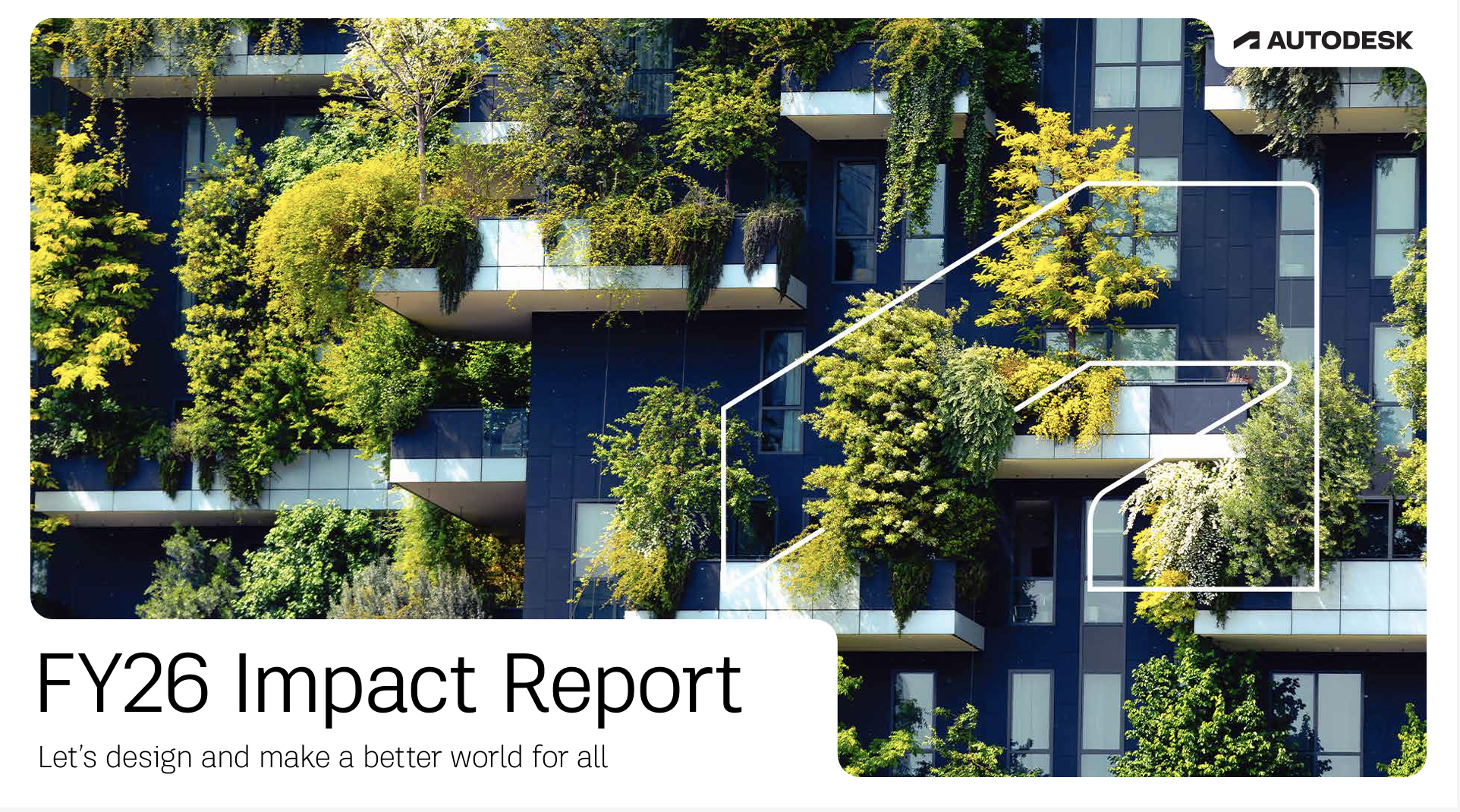
Autodesk’s FY26 Impact Report
Change across our industries continues to accelerate. Geopolitical uncertainty, energy market volatility, and the rapid scaling of artificial intelligence are reshaping how our customers plan, design, build, manufacture, and operate. Climate-related disclosure requirements are expanding across major economies. Climate risk is increasingly reflected in insurance and capital markets. And the capital investment cycle now underway—spanning AI infrastructure, energy systems, and industrial modernization—is one of the largest in a generation, with clean energy and electrification investments alone exceeding $2 trillion in the past year.* This landscape is becoming more complex and uneven across regions. While some markets face political headwinds and others move faster on regulation, our customers share a common challenge: delivering projects that are more efficient, resilient, and accountable while balancing cost, compliance, and speed. Autodesk sits at the center of this. As the platform where design and make workflows converge, we bring together industry expertise, connected data, and real-world context across the project lifecycle. AI is making our offerings more powerful. By applying AI within our platform, we help customers optimize designs in real time, accelerate modeling and iteration, and better understand tradeoffs among cost, performance, and sustainability. At the same time, the infrastructure required to power AI is creating new demands on energy systems. We are committed to being transparent about both sides of that equation and supporting AI that advances sustainable outcomes across our platform and the industries we serve. Our enterprise customers are increasingly linking sustainability performance to operational efficiency, project delivery, and long-term asset value. This is visible in customer priorities, from embodied carbon requirements in major capital projects to growing demand for tools that help teams evaluate cost and carbon together. Cost, efficiency, and sustainability are no longer separate conversations; they are converging. Within our own operations, we advanced our climate commitments in FY26 by expanding renewable energy procurement, investing in high-quality carbon removal, and managing the carbon footprint of our growing AI capabilities. We also procured sustainable aviation fuel to help address business travel emissions and support the development of lower-carbon fuel markets. Progress in our own operations is essential to our credibility as a partner to our customers and the industries we serve. We also invested in platform capabilities that make sustainability actionable within existing customer workflows. We advanced carbon measurement across the design and construction lifecycle, integrated new emissions datasets into our core tools, and demonstrated early AI applications that identify both cost and carbon savings on active projects. Forma Carbon Insights, for example, now enables teams to assess carbon impacts earlier in the design process, alongside cost and performance decisions. At the industry level, we expanded our work on the standards and data infrastructure needed to support the next generation of sustainable design and construction. Through our partnership with the World Business Council for Sustainable Development and leading global architecture and engineering firms, we are helping to drive greater consistency in how carbon is measured, reported, and reduced across building and infrastructure projects. Building long-term resilience across our industries also requires empowering people with capabilities to deliver better outcomes. Through Autodesk’s education initiatives, we equip students, educators, and the next generation of designers and makers with the skills, tools, and technology needed to address increasingly complex global challenges. Looking ahead, our priorities are clear. We will continue to lead through our own operations. We will scale the sustainability capabilities embedded across our platform. And we will help our customers and industries capture the growing demand for lower-carbon, higher-performance outcomes. The transition toward a more sustainable and resilient built environment and manufacturing sector is well underway, driven by economics, customer demand, and necessity. Autodesk is where many of the critical design, engineering, construction, manufacturing, and operational decisions get made, and we are committed to helping ensure those decisions lead to better outcomes for our customers, our employees, our investors, and the world we share.
Read Autodesk’s FY26 Impact Report
*BloombergNEF, “BloombergNEF Finds Global Energy Transition Investment Reached Record $2.3 Trillion in 2025, Up 8% from 2024,” January 2026